


 HACCP is a systematic preventive approach to food safety from biological, chemical, and physical hazards that may occur during production and which could cause the finished product to be unsafe.
This method seeks to find unsafe practices based on science, rather than on traditional “produce and sort” quality control methods.
HACCP is used in prevention rather than correction after final inspection, at all stages of a food chain. It focuses only on the health safety issues of a product and not the quality of the product.
Interesting facts:
HACCP was conceived in the 1960s when NASA decided a new approach was needed to test food safety. The reason behind this was that the old method left very little food that could actually be used after the testing was completed.
Pillsbury was asked to design and manufacture the first foods for space flights using NASA’s own requirements for Critical Control Points (CCP) as a guide to identify “critical failure areas” and then eliminate them from the system for food safety.
Pillsbury microbiologists were so pleased with the experience gained from the space program that they advocated that their company should adopt what would become HACCP standard at Pillsbury.
The organization of International HACCP Alliance was established in 1994 for the meat and poultry industries and now also includes the cosmetics and pharmaceutical industries.
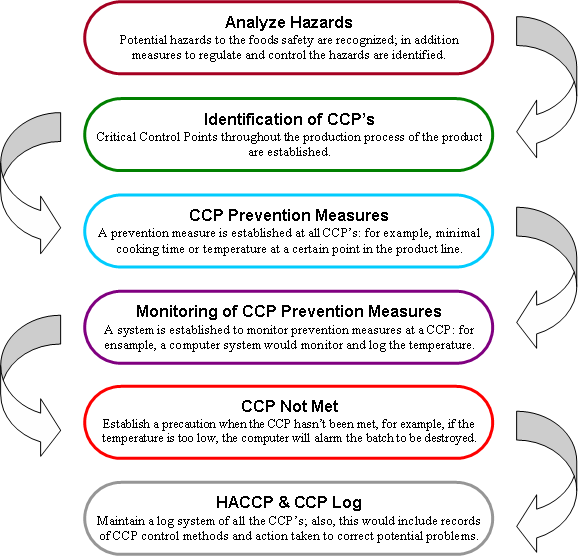 The Seven Principles of HACCP:
Conduct a hazard analysis
Plans determine the food safety hazards and identify the preventive measures the plan can apply to control these hazards. A food safety hazard is any biological, chemical, or physical property that may cause a food to be unsafe for human consumption.
Identify critical control points
A critical control point (CCP) is a point, step, or procedure in a food manufacturing process at which control can be applied and, as a result, a food safety hazard can be prevented, eliminated, or reduced to an acceptable level.
Establish critical limits for each critical control point
A critical limit is the maximum or minimum value to which a physical, biological, or chemical hazard must be controlled at a critical control point to prevent, eliminate, or reduce to an acceptable level.
Establish critical control point monitoring requirements
Monitoring activities are necessary to ensure that the process is under control at each critical control point.
Establish corrective actions
These are actions to be taken when monitoring indicates a deviation from an established critical limit. Corrective actions are intended to ensure that no product is dangerous to health or contaminated and that it does not enter the commerce market.
Establish procedures for ensuring the HACCP system is working as intended
Validation ensures that the plants do what they were designed to do; that is, they are successful in ensuring the production of a safe product. Verification ensures the HACCP plan is adequate and that it is working as intended.
Establish record keeping procedures
The HACCP regulation requires that all plants maintain certain documents, including its hazard analysis and written HACCP plan, and records documenting the monitoring of critical control points, critical limits, verification activities, and the handling of processing deviations. Implementation involves monitoring, verifying, and validating of the daily work that is compliant with regulatory requirements in all stages all the time.
 The FAO/WHO has also published guidelines for all governments to handle the issue in smaller and less developed food businesses.
With all the information regarding HACCP at our fingertips, we are sure this will assist our customers to be one step ahead of their competition, if and when, they need to start becoming HACCP compliant.
Our goal is to be here for our customers when they require anything in this industry and we encourage them to contact us with any queries.